Showing posts with label Anecdotal. Show all posts

08 October 2014

Let's Talk about Pics, Baby.

I spent some time this week at the OTA/EM Conference. It was really really good. Our keynote yesterday was by a guy named George Couros. One of the things he said that stood out to me was, "We get what we model." Meaning, whatever we model to our students, that's what they are going to give us back.

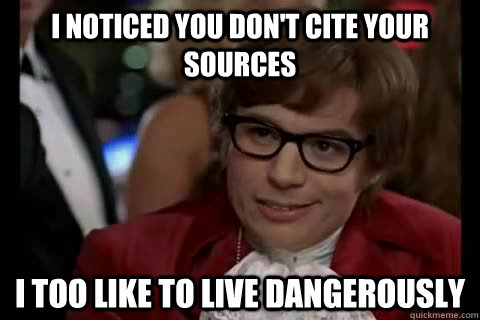
So, when we give presentations, shouldn't we cite our images? If we don't, should we be allowed to deduct points when students don't cite their images? If students cite their images with the words, "Google Images1," should that be sufficient? I'm sorry if this sounds rude, but we've all had a course in which we have written. In which we have researched. In which we have used outside sources. In which we have been required to cite those sources.

So, should we (as professionals - who want to be TREATED like professionals) follow the rules of academia? If not, why not?

Image courtesy of quickmeme.com - used without permission


1Citing something with Google Images is kind of like citing the library. "Why yes Mr. Bowie, I did get this from an outside source. I got it from the public library!" WHERE DID YOU GET THE IMAGE?

09 November 2011

You want spoonfeeding? Sorry, no can do

I am really struggling to write here. When in the course of my jobs I write something that I feel is appropriate to post, I'll do so.

The following is a response to a student. I'll let you draw conclusions based on what I say (said).
You said "I understand that we are adults, but I am paying a hefty tuition for a professor to teach me." You will probably be sorely disappointed in this class if that is your expectation. I am a facilitator of learning and much of what you do and learn in this class will be a result of independent learning. As a teacher, I hope your other professors will do the same. Knowing the mission of professional studies as I do, that is the intent, although it doesn't always happen in actuality.

Education has changed significantly over the last 10 years. A major change has been that the impetus for learning has moved from the teacher to the student. This is true in MANY progressive universities and it's how I structured my classes in both the university and the high school. I've learned a lot of what I do from other, veteran professors here on campus, so I know you will run across these same strategies in other classes; some of those profs teach in this program.

That said, I recognize that the program is expensive. I just spent over $30k for a Master's. However, I didn't pay for a professor to teach me. I paid for convenience (1 night a week) and for a professor to know how to engage me in the learning process, whether through lecture or independent learning. My philosophy is that you get out of class what you put into it.

It is my job to bring all of my mental faculties to bear on the learning environment so that it is one that is conducive to students being engaged and learning However, it is your job to come prepared to class (which you clearly do) and do your best on each assignment and while you are participating in class. I say things like "You are college students and need to figure things that are not spelled out on your own" because that is what is expected of college graduates. You should be a critical thinker, a problem-solver, and an independent learner.

This week, I was asked to prepare an RFP for a vendor. Prior to that assignment, I had never heard of an RFP and didn't even know what the letters stood for. However, through a day of research and independent learning, I was able to learn not only what it was, but what was supposed to be included in one and I prepared a (very) rough draft. This was done much to the surprise of my boss. She didn't even expect that I would know what it was, no less be able to create one from scratch. I learned that skill through professors putting me into situations in which I had to think for myself. This is exactly one of the skills I am hoping to engage you in. Be sure to check the learning objectives again. No doubt you will see "critical thinking" listed.

This program is not about (at least it shouldn't be) "paying for a degree" or even "paying for a professor to teach you". It is about you engaging in the process of learning. Many students come to SNU thinking the professor should "spoon-feed" them the information, assign them an "A", and get them on to the next class. I refuse! I will point you in the right direction, facilitate learning to the best of my ability, award points where they are due, and PREPARE you for whatever challenge you meet next.

You guys know how these things go. Sometimes you've just got to get these things out of your head before you can move on.

19 August 2011

My Final Duty

Putnam City has a tradition in which the previous Teacher of the Year speaks to the district faculty on opening day. Ive got to say, I was really looking forward to this. There's something very exhilarating about standing up in front of a captive audience of about 1200 professionals and telling them what's on your mind. I think my experience at IgniteOKC gave me a taste of public speaking and I like it! I'm not saying I'm good at it, but I enjoy it. When you have people clapping (even if you told them to) or laughing or even cheering, it gets the adrenaline going. It was a great experience.

I talked about the Common Core and I'm afraid I stole some (or a lot) of the superintendent's thunder. I felt pretty bad about that, but much better when several people asked if they could have a copy of my speech. So here you go: (it's long - as usual) I just cut and pasted from my notes, so please forgive any grammar and punctuation errors. I write just like I talk.

By the way, I sitting in Logan Airport in Boston, on my way home from a STEM plan learning lab. I'll debrief on that in another post. It was an enlightening experience in so many ways.


I’d like to start out by saying thank you to Mr. Hurst and the rest of the administration for the opportunity to speak to you all today. I was honored to be chosen as your Teacher of the Year for 2011. Being selected as a State Teacher of the Year finalist made my decision to take the Science Director job a very difficult one. In fact, I can easily say it was one of the most difficult decisions ever. I’m so proud to be a part of the Putnam City Schools family and I wanted so badly to represent each of you at the state level. Thank you so much for the opportunity to do so and I’m sorry I had to drop out of the competition because of this new responsibility.

Now if you’ve never spoken to a group this large, know that it can make you a bit nervous. I’ll just say that if I say something you agree with or that resonates with you, or even if I just mention your school, to let me know you are listening, you can clap or say something like woo-hoo!

15 years ago, I applied to be a bus driver in Putnam City Schools. I was hired and drove off and on for 10 years until I finally finished my undergraduate degree at SNU in 2007. During those years, I came into contact with what I believe to be the greatest faculty in the State of Oklahoma. As a bus driver, you certainly get a different perspective of the students and faculty. My time as a bus driver allowed me to learn what caring about students means and I learned that from you guys. One of the schools I drove out of was Tulakes Elementary (anyone here from there?) Every day the teachers would bring the students to the bus. They would get on the bus with the students and they showed me what an example of a caring teacher looked like. If a student was having a bad day or if they knew of some particular difficulty at home, the teachers made sure I knew about it. I have no doubt that this type of thing continues across the district in other schools and on other buses.  Little did I know back then, that I would get the privilege to join the faculty of Putnam City, a fantastic group of educators and that I would be afforded the opportunity to teach the best students in the state.

Speaking of great students, my own kids, Jessica and JC, have been in Putnam City their entire lives and I’d like to publicly thank each of you who influenced them during their time here. When I first started driving a bus, I applied for a transfer into the district so Jess could begin Kindergarten at Overholser Elementary. About that time, we moved into the district and the kids attended Rollingwood, Capps, and most recently, Putnam City High School. Jess graduated last year and JC will be a Senior this year. We were purposeful about purchasing a home in the district so our kids could attend school in Putnam City because we believed then, and still do, that the district offers the best academic and extra-curricular opportunities in Oklahoma. Because of the relationships I’ve built and the quality of education my children have received, I will always consider Putnam City Schools my home.

For those of you who are new to Putnam City this year, I want you to know that this is a special place. If I were to go into all the reasons for making such a broad statement, we would be here all day and I doubt any of you want that. (that is an appropriate place for applause) I’ll just say that there is a sense of family among the teachers in each building that I’ve not experienced in any other workplace. I’m thankful for the community that teachers and administrators work hard to build. If you don’t feel that in your building, I hope you do whatever it takes to treat your colleagues as family (or in some cases, better than family). It creates an environment of support and makes Putnam City a great place for students to learn.

The faculty members in this district have challenged me to grow and the members of the administration have given me opportunities to facilitate that growth. I have been fortunate to have leaders who allowed me the chance to try new things in my classroom. This led to an enriching teaching experience for me and hopefully a positive learning environment for my students. I hope the administrators in the district will continue to allow teachers to innovate in the classroom. Principals, if you aren’t already doing that, I’d challenge you to give your teachers some slack and see just what kind of excitement they can generate in their classes.

As I have begun to transition into the job of Science Director at the State Department of Education, I am beginning to realize that the change we’ve all been looking for in education is here. I doubt you’ve been able to read any journal or website without hearing about the Common Core State Standards Initiative. I’m not here to tell you that the Common Core standards are the saviour of education, but I do think they are common ground with which we can all start to increase the rigor and relevancy of our classes. If you don’t know about the Common Core, you should get informed. You can find information on the State Department of Education’s website or at corestandards.org. I thought I might share just a little of my understanding of the Standards (I’m talking to you as a teacher as a teacher, not as the State Science Director, give me a little slack, I’ve only been on the job for 3 weeks!)

The major components of the Common Core are this:

Include more reading and writing of informational texts in all content areas. - This isn’t really anything new. We’ve been talking about having students read and write for quite a while. Yes, you CAN have students in an English class learning to read and interpret a historical document. In fact, that is just the kind of thing the core standards encourage you to do. Literacy is everyone’s job. Think about it, if a student cannot read or write at grade level, how can they interact with the rest of their education? I guarantee you can connect literacy strategies to every single subject area in every single grade. If not, you are probably doing it wrong.

Provide opportunities for students to practice the 3 modes of rhetorical writing (narrative, argument, and informational) I can tell you from experience, when students enter college, they are going to have to do each of these three kinds of writing, probably in their first composition class. It doesn’t mean they have to be able to do them perfectly, but they should have already been exposed to this kind of writing, at a minimum. This isn’t just at the secondary level, either. Elementary students should be practicing their writing skills. How about having them write out the directions on how to accomplish a task and then let another student follow those directions?  

Require students to supply evidence and/or reasoning to justify their position. This can be mathematical reasoning, evidence from a text when analyzing literature, or scientific evidence from observation or experimentation. It doesn’t really matter what the topic is, but students must be able to give a reason for why they think a certain way or believe something. In this case, the process by which a student arrives at an answer is just as important as what their answer is. This may mean that you put students in a position in which there is either more than one right answer, or (heaven forbid) a situation in which you, as the teacher, do not know the right answer.
Expose students to grade-appropriate texts (which may be more complex than they have been in the past). The core standards are very explicit in giving examples of the kinds of texts students should be reading and at what level they should do so. Notice I said examples, I didn’t say mandates.

Use student work from each grade level to show proficiency (This is clearly a situation in which a series of GoogleDocs would work great as an e-portfolio!) This is a big part of the Common Core: being able to show that students are proficient at a particular skill. Just as the students should be able to give evidence of their reasoning, you as teachers should be able to give reasoning that supports your assertion that students are proficient in a particular area. We must be purposeful in causing opportunities for students to create artifacts that will demonstrate proficiency.

Teach using real world examples.  I’ll talk more about this shortly. I’m really passionate about this one, and I’ll tell you why in just a minute.

Integrate technology into instruction. Yes, the Common Core is very explicit on this one. The students Quote “use technology and digital media strategically and capably.” end quote. And they are not just using technology just to be using it. They quote “employ technology thoughtfully to enhance their reading, writing, speaking, listening, and language use.” end quote Ha! Some of you thought technology would decrease their language skills! Try having your students summarize a story or a semester-long project into 140 characters or less (maybe using twitter or polleverywhere). You will see some students writing more creatively and being more excited about what they are doing than ever before. Innovation like this will require training for students and teachers, I recognize that. In fact, it will probably require you as educators to begin doing some independent research into the use of technology in your classroom. I won’t lie. It’s not going to be easy. But then nothing worth doing ever is. If you need help with technology, I know of several people in the Putnam City technology department who are more than willing to help, you just need to ask. I’ve also heard there are some new instructional coaches who will be able to provide you with some much needed innovation assistance, as well.

Enough of what the Common Core is. Let me tell you what it is not.

The standards are NOT a national curriculum. They do not tell you how to teach your content. You should rely on your own professionalism, your district curriculum directors, and the collective wisdom and experience of your colleagues to help guide you in this area.

PThe Standards are not a comprehensive guide as to what should be taught, they are the minimum of what students should know and be able to do. However, those minimum guidelines are pretty explicit. For example, if you have students who cannot use the words their, there, and they’re correctly, they haven’t shown proficiency for what they should be able to do by the end of the 4th grade. Yes, I did choose that one because its a pet-peeve of mine.

The Standards do NOT include interventions for students below grade level and English Language Learners. However, PLCs can provide assistance with below-grade level interventions and I’m sure the ELL teachers are happy to help, as well. You have resources, but you have to ask for help!
Finally, the Standards do not define every single thing students need in order to be college and career ready. Teachers, districts, and states have some leeway on considerations as to what else is needed for students.

After stepping into the shallow end of the pool with the Standards I can tell you this: As an educator, there’s nothing in the Common Core I have seen that we shouldn’t already be doing.

My wife teaches at a local university, so you can imagine that we spend a significant amount of time talking about students, about teaching, and about our own learning. There is one thing she talks alot about that is a common struggle for many students arriving at college: the ability to think critically. The skill of analyzing a text or a situation and being able to cite specific evidence to support their position is something with which many students struggle. That’s a significant part of what Common Core is about: critical thinking. At the college level, students can still learn new content, but if they come in without the ability to think critically, they have a significantly smaller chance of academic success, no matter what their major is. Additionally, when students enter a workplace, they can learn how to run a cash register, but the ability to deal with a new situation requires problem-solving!

As a science teacher, I get really excited when I read anything that says students should be able to quote “evaluate the argument... including the validity of the reasoning... and sufficiency of the evidence”! end quote.  I heard someone on NPR the other day talking about gas wells and how they have a new method of getting more gas out of those old wells. If you were my family, I’d explain exactly how they do that, but suffice to say, there is a large group of people who are concerned about the contamination of ground water because of this new practice. The group is pushing for full disclosure of chemical levels in ground water before and after the drilling process. The host said, and I quote “The public needs some evidence so they will know the practice is safe.” end quote.  Really? How many average people in this country would be willing or capable of looking at evidence and drawing a reasonable conclusion? I suspect the average person would be willing to let some reporter interpret the evidence and tell them what to think. Consider that when you would rather let your students memorize facts instead of putting them into critical thinking situations.

I give this example because another significant part of the Common Core is relevance. I told you earlier I would get back to “Teach Using Real Life Examples”  As teachers, we owe it to our students to show that what they are required to learn is going to be useful later in life (or at least in a later class). In my physics classes, you cannot imagine the excitement on students’ faces when we would take some algebra or trig function and leverage that to actually learn about the position of an object or some force being applied! If you can’t make your subject relevant to students, you should reconsider what you are teaching. I’m not saying its easy to make your class relevant to students’ lives (unless you teach physics), I’m just saying you owe it to them to be explicit in that relevancy. This is especially important as students get into late elementary and middle school and begin to wonder, “What am I even doing in school anyway? What’s the point of all of this?” If we wait until students begin their high school years to introduce the relevance of learning, school may be so irrelevant by that point, they won’t be inclined to listen.

I’m so proud of each of you and I know this year is going to be better than the last. I hope if there is anything I can do to help you, (especially in science) that you will contact me. I’ll be looking forward to hearing about the exciting things going on in Putnam City. I hope you have a great year and I appreciate you giving me the chance to speak today.
27 July 2011

new beginnings

This has been a week of transition. I have accepted the position of Science Curriculum Coordinator for the Oklahoma State Department of Education. I've said for a long time that teaching physics at Putnam City High School was the last job I would ever want, meaning it is literally the last job I ever wanted to have. However, sometimes opportunities present themselves and you feel like you cannot pass them by (lest they do not return!)

In my next to last Master's class, I was working with a group of people and one of them said, "You know that the Science Curriculum Director position is open? You would be awesome at that, you should apply!" I said, "No, I didn't know that. I'm not sure that's something I would want to do. I mean, I'd have to leave my classroom!" So I went down home that evening after class and talked to @mishelleyb and we decided that the only way I would know if I wanted to do that job was to apply and interview. So, in April I applied. Knowing how little experience teaching I have had, I did not think I had any chance at even interviewing for the job. Honestly, once I applied, I totally forgot about it.

I moved forward with the State Teacher of the Year application and focused on teaching to the best of my ability. I didn't give Science Director another thought. As we were on our way to Philadelphia for the International Society of Technology in Education Conference, I received a phone call from the Asst. Superintendent of Curriculum about presenting at a conference in Oklahoma City. In the course of that conversation she mentioned my application and assured me that I would be called for an interview. This was completely out of left field as I was so nervous about making the finals for State TOY. At that time, I was informed that there might come a time when I would have to choose between TOY and Science Director. Uh, can you say no-brainer? TOY is a big honor. In fact, for me, its been huge. However, to be able to influence teachers beyond my district and to be able to affect change in science education versus being a spokeperson for the vocation of teaching? Yeah, not really a difficult decision.

What was a difficult decision was leaving my classroom. It was incredibly hard to think about leaving my students to be taught physics by someone else. However, knowing I would have some influence on that teacher and others who teach science across the State of Oklahoma helped make this much less difficult. In the course of the interview I learned that a significant part of this job is focused on teaching teachers, e.g. conducting professional development. This is something about which I am passionate. In fact, I'm as passionate about that as I am about teaching physics and earth science, so how could I say if they offered?

To make a long story short, I interviewed for the job last week and they offered the position to me on Monday and I have accepted.

I start next Monday and I believe I am going to hit the ground running. We are conducting Master Teacher Academy 3 days of next week and then I am going to a workshop to begin assisting in the process of developing a STEM plan for the State of Oklahoma. I mean, really? That's the kind of responsibility I have now? Oh, my. What have I gotten myself into? I've certainly moving out of my comfort zone. It feels like starting over in teaching. I feel like I'm about to start my first year again.

I do know this, I am going into an office in which there are other Directors who are experienced and are excited about me coming to work with them. We are moving towards the Common Core and we have already re-done our science standards and I'll be helping to implement those. The team I am going to work with is awesome from what I hear.

I'll be continuing this blog in its current format. I'm continuing my education and this will simply be a place to share what I am doing in my teaching (I'm still adjuncting 3 classes for SNU) and my learning (I am beginning to understand just how much I don't know). If you enjoy reading, I hope you will continue to do so.

17 June 2010

what its like being married to the smartest woman I know

Galveston SunriseWe are in Galveston on vacation. Every other year, we spend a week or so with @mishelleyb's entire family at an exotic locale like Pigeon Forge, Tennessee or Cedar Creek Reservoir near Dallas, Texas. Seriously, I know those are not exotic locations. What they always turn out to be are fantastic times of bonding with my in-Laws, including both of my brother-in-laws and my sister-in-laws. I also get to spend some quality time with my own kids and some really great nieces. Suffice to say we always have a great time. This year we decided to go ahead and take a trip even though this is an off year (we were together last year) and so we ended up in Galveston, Texas at a great house that is literally on the beach. As I write this, I am sitting on the deck watching and listening to the waves break about 20 meters away. Its awesome!


So, about being married to a wonderful, smart woman (who also happens to have a fantastic family). @mishelleyb and I went into town for a drive this morning (we are staying about 35 km south of Galveston near Jamaica Beach) because we enjoy looking at old stuff. We drove into downtown and walked for a bit in the area known as the Strand. Its on the Bay side of Galveston and used to be a natural deep-water port. Merchants would literally offload goods from ships into the back of their establishments and sell them out of the front. That kind of blows my mind to think about, I mean those guys must have been making some serious bank! Sorry for the digression... while we were driving around on Seawall Avenue (aptly named) we noticed a large group of students, probably in either high school or early college. They were all listening to a guy give announcements for what we suspected was some kind of community project. The oil spill hasn't reached the Texas Coast, so we have no idea to what their service project would pertain.


Seeing these students turned our conversation to school and learning, which is typical and really is the point of this post. She had a brilliant idea for a cross-curricular project and now I really want to design the curriculum and present it to a local community college! Of course I know this is talk, but we often enjoy talking about things we will probably never do.


So here's the idea: Three teachers collaborate to create a humanities course called Cultural Studies: The Island. The English teacher  (@mishelleyb) would teach island literature. This could be very broad if there wasn't enough specific Galvestonian lit (honestly, we haven't done any research so we were unsure of the amount available for study). A history teacher could cover everything from the history of the island itself to the historical ramifications of natural disasters such as the Hurricane of 1905 and Hurricane Ike (which still shows its ugly damage nearly 2 years later). That could go in so many different directions, it would probably have to be very focused to fit within the month-long time frame of our imaginary course. Of course, I would be remiss if I didn't mention the science aspect of anything (since I teach Physics - the Study of Everything). I would lead a study of weather, specifically coastal weather, more specifically Hurricane development and damage assessment. I would also like to include a study of waves and tides. These two subjects would include gravity and simple harmonic motion (at least the basics of each.) This class would be taught through the local community college (I'd be surprised if there's not already something like it) as a 4 hour humanities class. It would a student chosen capstone project that could be from any of the 3 disciplines. Hold class a few hours a day and then have the rest of the day to explore, shop, study, and enjoy living "the Island Life." What do you think?


So how does all of this relate to my joy in being married? This conversation is not something out of the ordinary. It is so fulfilling to be able to talk about "work" as something I enjoy. I get immense satisfaction having "work" in common with my wife and being able to spend this kind of quality time together (we have the entire summer), but not forget what we do the other 10 months of the year (if you think teachers only work 9 months a year, think again!) It is fantastic to be married to someone who makes me want to be a better person. To be married to someone who likes many of the same things I do. To be married to someone who plans trips that include things I like (that's another post).


When I think about the person I am now (educationally) compared to who I was 6 years ago, it's mind-boggling. Back then, I was a window tinter who worked my hardest in the summer and didn't have to use my brain much. When I went back to school, I was unsure of the path I would take. I certainly didn't think I would be going into my last year of a Master's Program and preparing to teach my first college course in the fall, with two more in the spring. They are adjunct classes, but still, it's college! I am now in a job that gives me a tremendous amount of satisfaction and has a huge amount of room for growth. While my wonderful wife wasn't necessarily the single impetus for me returning to school, she has certainly been a great partner in this journey of growth, so far. She is an inspiration as a teacher (she does relationships with students very well), is a great sounding board for decisions, and is a constant stream of knowledge when it comes to curriculum design for the Physics students at Putnam City High School. So, thanks Michelle!

27 May 2010

Has this ever happened to you?

Tell me if this has ever happened to you: you realize that your pockets feel light and you think you have lost your keys (yes, like the keys to get into the school!). You think, well, I had them about 2 hours ago when I ran to the school, so they cannot be too far. You check your man purse, your books, your pockets like 59 times, the classroom in which you currently reside, only to realize that they are nowhere to be found! So, you hop on the motorcycle and drive about a half mile (retracing your route to SNU) and there, at the corner of 42nd and MacArthur, are your keys, lanyard and all. Has that ever happened to you? Because, yes, it JUST happened to me!

23 November 2009

just some thoughts on the day

It was a day like any other day (except for the fact that it was Monday, but seemed like a Thursday since tomorrow is Tuesday, but is really Friday). I made it through 1st and 2nd block easily, but then 3rd block rolled around. Not that I have anything against 3rd block. Really. I don't. But it started off with a very nasty habit many of the students in that block have: being polite. Yes, they are polite to a fault. I'll try to explain.


Students are tardy if the they enter the classroom after the tardy bell rings. Makes sense, right? At Putnam City, all of the doors are kept locked when shut, therefore, students cannot enter the classroom late, unless someone opens the door for them. And therein lies the problem with their politeness. I'll continue to explain. I usually stand at the door and close it just as the tardy bell rings. I then proceed to get students going on the bellwork or whatever other task I have for them to start class. This means I am not at the door and cannot see who comes in late to class. There is a sign on my door, which says "For entry, knock politely" which students read "To sneak in, knock quietly". This is what usually happens. Students knock quietly and my students, being the polite human beings they are, open the door and return to their seat. Usually before I can see who is coming in tardy.


So there you have it, my students are annoyingly polite! This put me in a other than pleasant mood since it happened once, I addressed it, and then it happened twice more! We then proceeded to submit papers to turnitin.com, which you don't even want to hear about. Really. I'm not going to talk about it.


That was the "bad" part of my day. Not very bad, right? I didn't think so either. I love my job. And therein lies the good part of my day. I went up to the teacher workroom to check my mail box and was greeted by a fluorescent pink sheet of paper there in the box. What was this pink paper? Glad you asked. It was the final ballot of the "teacher of the year" voting for our school. You might ask why that is significant. My colleagues have voted me through the first two rounds which means I'm on the final ballot "against" two other teachers. Knowing these two people, there's no way I have a chance to be voted teacher of the year for Putnam City High School, but that's okay. The other two teachers are the type of teachers who make an impact on students and they are both very deserving and after all, that's what its all about anyway. Impacting students lives. I am just honored to be nominated. Thanks faculty, I appreciate your confidence.

02 November 2009

National Blog Posting Month

I will just say it: I am committing to writing a post each day. This probably isn't the best month to make that commitment, at least by looking at the calendar, but its already out in the blogosphere. No taking it back. I won't go back and edit this post to remove it. I am committed to each of you. I'm going to do my best to write something each day. It may just be an excerpt of something I am already writing, but I'm going to do something each day.  I mean, National Blog Posting Month doesn't come around every month, does it? Just between us, I think it does. I joined a ning today which is entitled NaBloPoMo (National Blog Posting Month) and they do a theme every month. This month is: No Theme. Of course! Its a sign from the Blog gods! I am very good at writing about nothing. It just so happens that I tend to write about science, education, and science education; so a month with no theme is a good thing.


Just to recap, I am committing today to write something every single day for the month of November. Thanks, justjessa. Into what have I gotten myself?


10 September 2009

Who knew Science was so dangerous? (aka my 100th post)

I think its very appropriate this post is the 100th to make to my blog. So, without delay, let's get to what I want to share: a day in the life of Bowie's Physics classes.

my trip to the ERToday was a crazy day. It started out like any other. I was able to remember that I had duty, so I went down there and "did my duty", literally.  First block went of without a hitch. We covered some homework and then proceeded to an activity I learned at an AP conference. Students stand one meter apart, stopwatches in hand, while another student (or myself) walks/runs/jogs past. Since they have all started their stopwatches at the same time, they stop their watch when I pass them. We use this data to make a graph of position vs. time. We interpolate and extrapolate. We find the slope of the line, which just happens to be the velocity. I show them how you can have a negative velocity. Literally, the activity is everything that is right about physics. Unless, of course, something goes wrong.

Like today, during second block. Things went horribly wrong. I changed things up a bit. Problem  #1: we did the activity inside, normally we do this outside, like we did in 1st block. Problem  #2: I was the person doing the walking/running/jogging, normally a student or two are the ones doing the running/walking/jogging (I'm no spring chicken anymore). Problem #3: I was wearing my most comfortable shoes, which also happen to be the worst shoes in which to run. Note to self: either wear your running shoes, or wear a helmet next time!

Trials 1-4: I walked, I jogged, I walked really slow, I walked backwards (negative velocity). Everything was fine. Trial 5: I decided to move at a variable velocity by starting at a walk, increasing to a run, then slowing back to a walk. And then it happened: I ran out of room when I got to the part where I should have been slowing to a walk. I put the brakes on and started to stumble. I had no more breaks, lost all control, and fell. My only thought was, "Hmmmm, there's the greenhouse (made of metal and glass) right in front of me. I'm going to go straight through the glass. This is going to be really bad." I went down and negatively accelerated my head in a very short amount of time, thereby splitting the back of my ear open. I immediately said a few words, which were hopefully not heard by my students, and  got up to sit on the bench in front of the greenhouse. I realized later this was the same bench that just a second ago was in contact with my ribs. I put my hand to the side of my head and thought, "Okay, this isn't that bad. But boy does this hurt!"

I looked up at my students and said, "Why don't we just skip Trial 6?" I looked down at my hand, upon removing it from the side of my head and realized I might have a couple of small cuts there, since I noticed some blood, but not an enormous amount. No problem. "Could someone get me some tissue?" Strangely enough, only one or two students were actually moving. (I think they were stunned that I was that clumsy.) Tissue arrives.

We returned to the classroom, I got them started entering their data into the excel spreadsheet. Standard operating procedure for this activity. I walked over to the stunned look of my department head and asked would he mind keeping an eye on my class while I walked to the nurse to get a band-aid on these little cuts on my ear. Of course, that was after an abbreviated description of what had just transpired. I look in on my students and said, "I'll be back in a little bit. Mr. Stark is across the hall if you need someone."

I proceed to the nurse's office, all the while noticing there is now a considerable amount of blood on my tissue. Concern begins to set in. I arrived, again to the stunned look of the school nurse. I explain. She says, "Let me see!" I remove my hand and she informs me that I have a "gaping hole back here". I immediately go into shock. I begin to sweat. The color, all of the color, leaves my face. I don't feel so well. I lay down. She recommends that I go to an after hours clinic. Then, upon further inspection and a pupil exam, she thinks I may need to go to the emergency room. I really begin to panic a bit. I show panic by the above listed symptoms. My symptoms increase, which does nothing to alleviate my panic (or my symptoms).

Michelle (my wonderful and amazing wife) decides to come take me when the word ER is mentioned. Initially, Jessica (my exceptional daughter) was going to drive me. We decide against that. I talk the nurse. It is worth mentioning that Michelle is on pain killers for some dental work which she had done yesterday. She may be over the legal limit as far as narcotics and driving goes. We're not really sure and frankly don't want to know.

By this point, I have talked the nurse out of calling an ambulance. She rolls me out to the student pick-up area in the wheelchair. My symptoms begin to resurface as they had subsided after laying down for a bit. I feel worse. I really begin to feel terrible. I tell my caretakers, the nurse and Teri Voss (an asst. principal) that, "I'm just going lay down here on the ground". In front of the school. On the concrete. Is that weird? As I begin to get to the ground (on all fours) Michelle rounds the corner to pick me up. I'm sure her first thought upon seeing my condition, head wrapped bandage and all, was "Oh Lord! He's practically dying. I'm just in time to say goodbye!"

To make a long story (somewhat) short, we get to the hospital. The doctor reassures me that I do not have a nasty head trauma and that I will be fine. I just need, oh about 15 stitches. Yes. From the top of my ear to the bottom, I am stitched. My ER experience was quite jovial, once I realized I wasn't going to die or forget who Michelle is (at least not anytime soon). I twittered while there. I even twitpic'ed.

The doctor and nurses were very understanding and made my time almost enjoyable. It takes an amazing person to do their job. Next time you talk to a doctor or a nurse, thank them for me. After all, someone has to pick up the pieces after we are done doing dangerous science!


Update: Breaking Video!

I was able to get some video of my accident. Enjoy!


09 August 2009

A "working" summer

This summer has been the busiest so far, at least since I've been teaching. I used to tint windows, so summers were my busy season. Its been refreshing to have a few weeks off to relax by the pool, catch up on some yard work, that kind of stuff.  This summer, I only had June to "goof off". I did do some pretty heavy goofing off, too! However, once July came around, I started going to Stillwater to Oklahoma State to do some research in the physics department. Specifically, I worked in High Energy Physics. Wow. That is some abstract, cool, mind-blowing stuff. It was awesome! I also was invited to present at the Oklahoma Alternative Education Conference. That was really good. I enjoyed presenting, but more than that I got some really good information that will carry over into my classroom. I did do a little bit of technology training during June. It was only three days, but I ended up getting a Mac out of the deal, so that was a really good deal. I also got to look at some great pedagogy methods for technology integration during the training. Plus, I was able to share my passion in a one day class I taught called Wikis, Blogs, and Discussion Boards. Definitely worth the time I spent preparing for it. I got good responses from the other teachers, so I guess it was as good for them as it was for me!


I guess I'll have to get used to this kind of stuff. I got so much out of my experiences I'm going to try to do some more of the same stuff next summer. The monetary compensation wasn't half bad either!

24 July 2009

why am i so fortunate?

Call it blessed, lucky, fortunate; it doesn't matter what name you give it, its me. Over the last year I have been blessed with so much technology, I don't know what to do with it all. Since January of 2008 I have received two laptops (1 PC and 1 Mac), a SmartBoard, a Cosmic Ray Detector, and basically anything else I ask for to outfit my classroom for student learning. I don't know what I have done to deserve this. I'm not anything special in the classroom. I don't "brown nose" to get what I want (do I?).


I know teachers who ask for this kind of equipment and never see half of what they ask for. I, on the other hand, don't even have to ask for stuff and I keep getting it! What's the deal? Just this week, my research mentor asked me if there was anything I would like to have for my classroom, physics related. She said they had some money left over from a grant and would like to buy some equipment for me. I thought to myself, "self, you'd better jump on this opportunity because this isn't going to happen very often". So I said Sure! I can find somethings I need. She encouraged me to ask for more than what I really wanted just in case the grant person decided it was too much to spend. I looked at some dynamics carts, motion detectors, and photogates (along with a few other things). I came up with about $1600 worth of stuff thinking "at least I can get the dynamics carts and track". Wrong! They approved it all! Of course my first thought was "I should have asked for more!" Then I realized what an arse that made me and I got into a thankful frame of mind.


I have no idea why these good things happen to me; but I sure am happy about it. So, thanks for the physics equipment, thanks for the MacBook, thanks for the SmartBoard, thanks for mounting my SmartBoard on the wall. Why thank you? Because ultimately its your tax dollars that are paying for these things and I really appreciate them!


as always, thanks for reading


jb

06 July 2009

Research Week 2

Here I sit, frustrated staring at 3 lines of code, trying to understand why the program keeps telling me I am trying to divide by zero. I honestly have no idea. I'm not sure just why I refuse to go and ask my mentor. I'm sure it's probably just a single variable out of place. Its amazing that coding can be so frustrating and so enjoyable all at the same time. I have made a ton of progress as far as C++ goes and my understanding of it; my ability to make it do what I want. But as I said, here I sit, frustrated.


On a positive note, as soon as I can get this figured out, I am going to start working with some real numbers, not with made up randomly generated numbers. I am looking forward to that! I want to see some real data.


And just that quickly, with another quick glance...its like putting my glasses on and seeing the code fresh and new! I realize that I have (for the umpteenth time) tried to abbreviate "parameter" as "p" instead of "par" as it should be and the program starts to work for me.  Now if I can just figure out why parameter #0 is "infinitely out of range". Curious.


edited update: of course! I had one single variable out of place and once fixed it worked perfectly!


jb

30 June 2009

Research Day 1

Yesterday was the first day of a research project I began through Quarknet at OSU. It was actually an interesting day although not necessarily what I had expected.

I arrived with plenty of time to spare and met my mentors, Dr. Flera Rizatdinova and Dr. Sasha Khanov. They are both high energy physicist who teach at OSU and are involved both with Fermilab and the LHC. They have so much knowledge and are more than willing to share it with me.  It seems as though Flera is into the actual data analysis side of things while Sasha is really good with computing and the hardware side. He is quite knowledgeable in different types of particle detectors.  BTW, they are actually married and have a couple of children who are both younger than 6. Apparently their son is obsessed with how things come apart and go back together. Sounds like a little scientist in the making. Both Flera and Sasha are from Russia, but met at Kansas State.

My morning was filled with a computing class from Sasha and some general knowledge from Flera about the Z boson and how they use the Root program to detect different types of particles.  Root is an open source program which was written by the physicists at CERN to analyze their data. I got a brief intro to it coupled with an introduction to UNIX. I have never worked in either, so it was quite a morning.

After lunch, we met again and I was instructed to play around within the Root program and UNIX.  Its kind of like learning to drive a car without understanding how the car actaully works. This a problem for me since I really like to understand how things actually do what they do. Suffice to say I just accepted my lot in life because there is no way I can learn everything!  I am just going to try to pick up some data analysis skills and computing knowledge during these 4 weeks.

I am beginning to feel a little more comfortable just navigating around within UNIX and Root; now its time to actually start manipulating some of the different code modules so I can get a handle on how to make Root do something for me, instead of me just looking at other peoples data.

Stay tuned...

08 June 2009

Vacation is over

This week begins with thoughts of technology. Tomorrow I'm teaching a tech class to other teachers and then spend the rest of the week taking a tech class. Next week is Quarknet which is the beginning of a summer research opportunity for me. That will take me all the way up to the week before school which is when I get trained on our new administration program, Powerschool, at the beginning of the week and then I begin training others the rest of the week. I'm not complaining, mind you; I'm just commenting. I do feel a little sad that I won't get much of a summer, but I am excited to get all of the training I am going to receive over the break.

31 March 2009

The Production of Knowledge

I was struck full in the face just how quickly we can access information about society in this day and age. I was watching American Idol (of course we DVR it so we don't have to watch the commercials), and Adam Lambert sang an old Wild Cherry song, "Play that Funky Music White Boy". I thought Rick James had done that song and I knew Vanilla Ice covered it at one time. I decided to google the song and found this article on wikipedia. I could not believe that the page had been updated with information about Lambert's performance of the song before the show was even over! I was blown away!

I talk in my class about how quickly we are able to access knowledge and this is just a really fine example of how quickly our society produces knowledge. According to @mishelleyb "Not only can we be consumers of knowledge, we can be producers of it and that production can be instantaneous!" I sit writing this post, thinking that someone, somewhere MIGHT be interested in reading what I have to say and the information I have to share is available within seconds of putting it into the keyboard of the laptop. Absolutely amazing. At no other time in history have people been able to say so much so quickly. I love it! Web 2.0 is the best!

22 March 2009

Spring Break is over

Time for the (short) haul to May 24th. I can't believe there are only 9 weeks left of school. Absolute insanity. I don't really understand what happens with the space-time continuum, but after I finished school, it was definitely interupted because I am definitely experiencing time dialation.  Last year was a blur and this year has been even worse.

I had a good break by doing some work in my kitchen (just paint) and just enjoying spending time with my @mishelleyb. She and I watched a ton of movies, did some shopping, and enjoyed each other's company.  It was great!

Now its time to think about work again. Time to get serious about the wiki. Time to get serious about preparing for the AP exam and plan some study sessions. Time to enjoy students again. Time to try to get students excited about Physics. I am going to plan a trip to a local amusement park next month. What better way to get them interested in physics than go to an amusement park? Should be fun.

Last, and certainly least, time to turn 40 next week. Yuck.

05 March 2009

An incredibly busy week

Mishelleyb and I have been quite busy this week.  We are the class sponsors of the sophomore class at SNU. That means we really just work with the class council to manage and plan the events for which our class is responsible. Its not a big deal unless (like us) you have to plan a totally new event from scratch which just happens to coincide with a band concert on the same weekend in the same venue.  This makes setup and rehearsal almost impossible. So this weekend is our event. It is called "who's the Man" and will be held in Herrick Auditorium at 1930 on Saturday night. We are excited about what it will look like, but its gonna be crazy for the next day or two. If we can make it to midnight on Saturday, we will be okay.

Maybe by then, my headache will go away.

25 February 2009

Teaching Science in the language of Mathematics

Those of you who have never taught math or science may not understand what we go through on a day to day basis here in the blurred world of science/math (aka Physics).  Let me give you some insight into my plight today while I was teaching centripetal acceleration.  I have students who are actually better at math than I am.  I know, I know.  I shouldn't be teaching physics if I don't know more about math than my students, but here we are!  I am learning so much everyday.


So, I had a student ask me a question like "where did the radians go?"  We were converting between tangential velocity and angular velocity and I was doing the unit conversion, just like I always do and I thought "Yeah!  Where DID the radians go?"  Honestly, I don't remember.  I told my students that, too.  "I really don't know."  I couldn't tell them.  I am sure there is some technical phrase like complementary adjacent angles that would perfectly describe what happens (I know its not complementary adjacent angles, so don't even go there); but I just had to tell them: "I don't know".  So, I read in the text.  I can't understand it.  I read again.  I am STILL not satisfied with the explanation to the extent that I am comfortable explaining it to students.


You may be saying about now..."So what happened Bowie?  Tell us! Tell us, please!"  Well, I will:  In walks another teacher who teaches Biology but knows a lot about units analysis (my term for it and I know Biology people do it too, I just don't think about them doing it.)  He and I start to talk about it and are still not entirely able to figure it out to our satisfaction.  Enter E.R. (his initials, not the Emergency Room), the brother of one of my best students from last year and proceeds to give us the vital piece of information required to connect the dots.  Voila!  I understand!  It was as if the light was turned on in my head.  It was something like what I imagine happens on a regular basis to my students when it all "comes together".  The vital piece was that I had never been taught (surely I didn't forget) what the definition of a radian is.  I just simply never bothered to find out! I never had a reason. Now I understand the "why" of the equation C=2πr for the circumference of a circle! I have known the how for a very long time.  I just never knew the why!


No big surprise that I learned something new.  My students never cease to amaze me by teaching me new stuff everyday.  I guess its just as amazing that I am willing to learn it.  Prayer: Lord please keep me willing to learn something new.


Thanks for reading.

24 February 2009

Two years ago this week

I went back to look at the things I had written in the past and thought 2 years was a sufficient amount of time (since I wasn't blogging at all before that time).  This is what I found from February 2007:


This past week student teaching was the most interesting yet. I actually fulfilled the long awaited "takeover" of the class on Wednesday. It was a momentous occasion when the students began to ask where the teacher was and when she would be back. The look on their faces was worth every dreadful hour I spent sitting in my chair wondering what I would do differently, given the opportunity. We are still finishing up genetics for the first two days of next week, but then we start space on Wednesday. I am pretty excited to be able to share some of my passion for astronomy with the students. I hope I will be successful in that. It's a tall order since they are just getting used to me, but I'll do my best. It's hard to believe I only have two weeks left there, but it's exciting to think about going to the high school. It is not, however, exciting to think about learning 100 new names of students. Oh well, such is the life of a teacher.I was able to exercise a little of my classroom management techniques on the class this week. It's been interesting to see how these kids react to me versus the normal teacher. My naturally loud voice really gets their attention when I choose to use it. It is usually followed up by "Mr. Bowie, why you yelling at us?" To which I reply, "You guys haven't heard me yell yet!" I try to be light hearted about that even when I feel angry. It's a real trial to not let the kids get the best of me. It's actually much more difficult than I thought it would be.


Stay tuned for updates on how my job search (had an interview this week) is going and how my last two weeks in middle school goes. Thanks for reading.

I remember that time.  I was still student teaching and couldn't wait to get in front of a classroom.  I thought then that I could do things so much better.  While that classroom was peppered with difficult students,  I was humbled to be in front them as a leader.  It all goes to show education is about relationships and I didn't have a relationship built with them yet.  I have worked on building relationships with my current students; I have worked especially hard on that this school year.  Its tough, but worth the effort.  There are few things in education that are so rewarding as when a student comes to share a personal problem with you or when they ask for a letter of recommendation because they feel you know them better than any other teacher.


I think SNU did another thing well: they taught me to reflect on my past experiences to become a lifelong learner. I hated those reflection papers in the School of Education at SNU, but it is surely helpful at this point in my career. I have, finally, learned reflection as a skill that will help me be better at what I do.


While I am by no means an expert on reflection, blogging is an activity that is very therapeutic for me.  Its like going to a counselor.  Maybe I should adopt that as my new mantra: "Blogging, cheaper than a psychologyist and just as good"!